Teach the Job Result, Not Just the Badge
 David Zenler

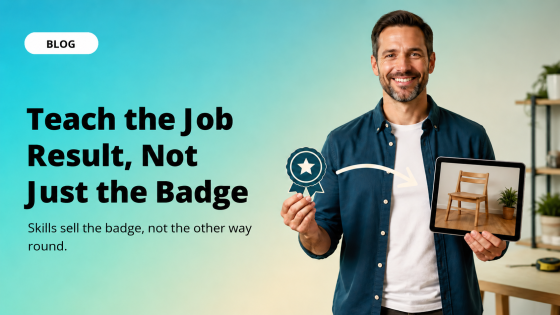
Create certification courses around real job outcomes, practical skills, and meaningful assessments that make every badge more valuable with Zenler.
Teach the job result first because learners value what the credential helps them do. The badge matters more when it represents a practical before-and-after: a task completed, a standard met, or a work result improved.
The title matters because it points to a decision, not just a slogan: Skills sell the badge, not the other way round. For creators who want their certification to mean something practical, that decision can change how people understand the offer, trust the creator, and take the next step.
The practical aim is simple: help creators connect the badge to a visible job outcome learners can use without adding noise, extra tools, or unnecessary complexity.
Why This Matters Now
Creators are publishing in a noisy market. Buyers have seen polished pages, generic AI content, vague promises, and endless course launches. What cuts through is not more volume. It is a clearer answer to a real problem.
The common mistake is selling the badge before proving the skill it represents. It may feel productive in the moment, but it often makes the learner or buyer do too much mental work.
When the message, product, and learning path are specific, people can understand the value faster. They know whether the offer is for them. They know what result to expect. They know why they should trust the next step.
This is where a strong Zenler setup helps. The page, course, checkout, email, community, and student journey can stay connected, so the creator is not constantly stitching together scattered tools just to deliver one clear promise.
How To Apply It In Zenler
Start with one focused move: name the real-world task, build lessons around the task, add feedback, and only award the certificate when the learner shows the result. Do not turn this into a giant rebuild. Make one change that improves clarity, then check whether people respond better.
Here is the idea in practice: A project management certificate should help learners build a real project plan, not just remember terminology. That kind of specific example is what makes the blog, page, course, or campaign feel useful rather than abstract.
Inside Zenler, look at the full journey. Does the page make the promise obvious? Does the lesson deliver a quick win? Does the email follow-up answer the next doubt? Does the offer tell people what happens after they click?
If any step feels fuzzy, simplify it. A good creator business does not need every possible feature switched on at once. It needs the right feature doing the right job at the right moment.
What To Include
Include the direct answer early. Readers should not have to scroll for three minutes before they know what you believe and what they should do next.
Include proof or a practical example. That might be a client story, a lesson breakdown, a before-and-after, a workflow, a template, a student result, or a simple explanation of why your method works.
Include one next action. If the reader is interested, do they know what to do now? If the student is inside the course, do they know what to complete next? If the buyer is on the page, do they know why the offer fits?
The best version feels direct, calm, and useful. It does not overhype the point. It explains why the point matters and gives the reader a way to act on it immediately.
Also include context. Tell the reader when this advice applies and when it does not. That stops the article from feeling like generic creator advice and makes it easier for the right person to recognise themselves.
Finally, connect the idea to the business result. Better lessons, clearer pages, stronger proof, better segmentation, or more focused offers are not just tidy improvements. They affect trust, completion, conversion, retention, and the creator's ability to keep selling without burning out.
A Simple Zenler Workflow
Turn the idea into a workflow rather than a loose intention. Start with the page or lesson where the problem appears. Identify what the reader or learner is trying to do at that moment. Then remove anything that distracts from that job.
Next, add the smallest support asset that helps the action happen. That might be a checklist, a replay, a certificate standard, a mobile-friendly lesson, a short email sequence, a segmentation question, or a more specific landing page.
Then connect the next step. If the person is a lead, guide them toward the offer. If they are a student, guide them toward completion. If they are a member, guide them back into the community or next useful resource.
This is the part many creators skip. They publish the asset, but they do not connect the asset to a journey. Zenler works best when each piece has a clear job and each job leads somewhere useful.
An Example You Can Model
Imagine a creator applying this to the topic of certification course outcome. Instead of making a broad page or lesson, they start with the exact question their audience is asking and answer it plainly.
They then add one grounded example: A project management certificate should help learners build a real project plan, not just remember terminology. From there, they add a practical next step so the reader can move from interest to action.
The result is not louder marketing. It is clearer marketing. The reader can see the promise, understand the proof, and decide whether the offer fits their situation.
That is what makes the blog more than a title. The title grabs attention, but the article has to earn it by giving the reader something they can use today.
What To Avoid
Avoid making the idea sound bigger than it is. Strong content does not need inflated language. It needs relevance, evidence, and a useful path forward.
Avoid copying generic advice without adding your own experience. The market already has enough flat content. Your edge is the judgment you bring from doing the work.
Avoid adding complexity just to look advanced. If a simpler page, lesson, segment, or live session gets the job done, use the simpler version first.
Avoid hiding the answer behind a long intro. Search readers and AI-assisted search summaries both reward content that gets to the point quickly and then supports the answer with depth.
Avoid treating every learner as if they have the same motivation, device, speed, confidence, and context. Better creator businesses make the journey easier for real people, not imaginary perfect students.
A Practical Checklist
Write the outcome in one sentence. Name who it is for. Name the situation where it matters. Name the mistake it prevents. Then add the smallest useful next step.
Check the mobile view, the headline, the first paragraph, the offer section, and the email follow-up. If the point is not obvious in each place, tighten the language.
Ask whether the content has an answer, an example, and a next step. Those three pieces turn a title into something useful.
Then publish the improvement. Momentum comes from shipping useful improvements, not endlessly polishing a version nobody has seen.
How To Measure It
Look for behaviour. Are people clicking, registering, replying, buying, finishing lessons, sharing wins, or asking better questions?
If nothing improves, locate the exact weak point. Traffic without opt-ins usually points to the page or lead magnet. Opt-ins without sales usually points to the offer or follow-up. Sales without progress usually points to lesson structure or support.
The goal is not to guess perfectly. The goal is to build a clean enough system that the next improvement becomes visible.
Related Posts
• How to create your first online course with Zenler
• Launch your first online class
Ready To Put This Into Practice?
If you remember one thing, make it this: Skills sell the badge, not the other way round. Turn that into one practical improvement inside your Zenler setup today.
Ready to package your expertise and sell with more confidence? Try Zenler risk free for 30 days and use the Accelerator Program to guide your next move.
FAQ
What does Teach the Job Result, Not Just the Badge mean?
Teach the job result first because learners value what the credential helps them do. The badge matters more when it represents a practical before-and-after: a task completed, a standard met, or a work result improved.
How do I apply this without overcomplicating it?
Start with one focused action: name the real-world task, build lessons around the task, add feedback, and only award the certificate when the learner shows the result Keep the first version simple, then improve it with real learner or buyer feedback.
Why does this matter for course creators?
It helps creators who want their certification to mean something practical connect the badge to a visible job outcome learners can use while making the learning or buying journey easier to understand.
How does Zenler help?
Zenler keeps pages, courses, checkout, email, community, webinars, and student access close together. That makes it easier to create a clear journey, test one improvement, and keep momentum.
Ready to create a certification course built around real skills and outcomes? Build, market, and sell your course with Zenler and manage your lessons, assessments, checkout, marketing, and student experience in one place.
Categories: : Online Course Creation
Copyright © 2026 Zenler. All rights reserved.
Terms | Privacy Policy | Cookie Policy | Support