Use Case Studies as Course Marketing
 David Zenler

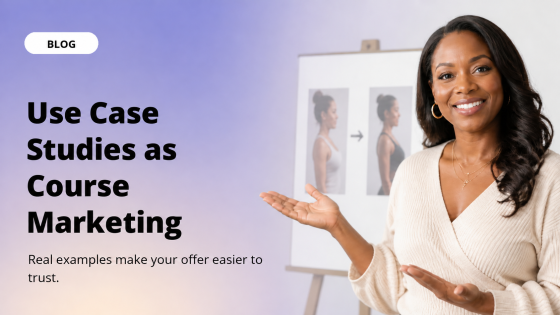
Use case studies and student results to build trust, prove your course value, and make your offer more believable with Zenler.
Case studies work because they show the offer in motion. Instead of asking buyers to believe a promise in the abstract, you show a real starting point, action, obstacle, and result.
For creators with student results, client stories, or practical proof they are not using well, this is not a throwaway tip. It affects how people understand your offer, how students move through the course, and how confidently you can sell the next step.
The practical result is simple: help you make offers more believable with specific examples without adding unnecessary complexity.
Why This Matters
Creators are surrounded by advice. Build more content. Post more often. Add more tools. Try the new tactic. The noise can make every decision feel urgent.
The real mistake is using generic testimonials when a clearer story would create more trust. It feels productive in the moment, but it often pulls attention away from the part that would actually move the business forward.
A useful creator business is built on clarity. The reader should know why the idea matters. The buyer should know what the offer helps them do. The student should know what to complete next.
This is where Zenler is useful because the pieces of the journey can stay connected. Your page, email, course, community, checkout, live session, and follow-up can support one clear path instead of competing with each other.
How To Apply This In Zenler
Start with one focused action: write one short case study that shows the before, process, result, and lesson for future buyers. Do not turn it into a big rebuild. One clean improvement is better than ten half-finished upgrades.
Here is a simple example: A course creator can show how one student went from a messy idea to a published offer page using the programme steps. Notice how specific that is. It gives the reader a real situation, not just a polished line.
Inside Zenler, look for the exact place where the idea should show up. It may belong on a landing page, in a Start Here lesson, inside a quiz, in an email, in a live session, or as part of your community rhythm.
Then make the next action obvious. If the person is a visitor, guide them toward a signup or offer. If they are a student, guide them toward progress. If they are a member, give them a reason to return.
What To Include
Include the direct answer early. Readers should not have to dig through a long introduction before they understand your point.
Include a real example or practical scenario. This makes the article feel grounded and helps the reader picture how the idea works in a real creator business.
Include one clear next step. The best content does not just explain the problem. It gives people a practical move they can make today.
Include context too. Tell the reader when this advice applies, when it may not, and what to watch for. That kind of judgement is what makes the article feel human.
Finally, connect the idea to the business result. Better onboarding, clearer offers, stronger community, smarter SEO, better quizzes, or simpler systems all affect trust, completion, retention, and sales.
Make the Title Earn Its Click
A strong title creates interest, but the article has to pay it off quickly. The reader should feel the promise being answered in the first few paragraphs, not saved for the end.
For this topic, the promise is not just 'Use Case Studies as Course Marketing'. The promise is that the reader will understand what to change, why it matters, and how to make the change inside a real creator business.
That means the article needs an answer, a reason, a method, and a visible next step. If one of those pieces is missing, the content may still sound good, but it will not be as useful as it could be.
This matters for search too. People do not search because they want vague inspiration. They search because they have a question, a problem, or a decision to make. The better your article helps with that moment, the more likely it is to be useful in organic search and AI-assisted answers.
A Simple Workflow You Can Use
Choose the asset that matters most right now. It might be one sales page, one course lesson, one weekly prompt, one waitlist page, one quiz, or one email.
Write the job of that asset in one sentence. If you cannot explain the job, the asset is probably trying to do too much.
Remove anything that distracts from the job. Then add the missing support: an example, a clearer headline, a stronger FAQ, a more obvious button, a student win, or a better explanation.
After that, connect the next step. This is the part that turns content into a journey. A good Zenler setup should not leave people wondering what to do after they read, watch, buy, or complete something.
Where Creators Often Miss the Opportunity
The opportunity is usually hiding in something ordinary. A repeated question. A lesson students keep skipping. A checkout page that creates hesitation. A quiet community. A page that almost answers the question but stops too early.
Creators often miss it because they are looking for a dramatic fix. They want the big campaign, the perfect funnel, the clever content angle, or the new platform feature. Sometimes those things help. Often, the better move is much plainer.
Look at what people are already doing. What are they clicking? Where do they stop? What do they ask before buying? What do students misunderstand? What do members return for? Those signals are more useful than guessing from scratch.
Use the title as a lens. If the point is real examples make your offer easier to trust., then ask where that idea should appear in your current setup. It may need to show up in your headline, first lesson, FAQ, welcome email, community prompt, or sales page proof.
This is how a small article becomes useful. It gives the reader a way to see their own business more clearly, then helps them make one decision with more confidence.
Common Mistakes To Avoid
Avoid making the idea bigger than it needs to be. Strong creator businesses are often improved by small, specific changes applied consistently.
Avoid hiding behind vague language. If the offer helps a specific person create a specific result, say that plainly.
Avoid copying another creator's system without understanding their stage. Their complexity may be useful at scale, but it may be a distraction for your next move.
Avoid treating content as finished just because it is published. Pages, lessons, emails, and quizzes get stronger when you improve them with real behaviour.
And avoid forgetting the human on the other side. Your reader, buyer, student, or member is busy. Make the path easier for them.
A Better Version Looks Like This
The better version is calm, specific, and easy to act on. It does not try to impress the reader with complexity. It gives them a clear answer and enough detail to use that answer today.
On a Zenler page, that might mean a sharper headline, a more useful FAQ, a cleaner curriculum preview, or a clearer explanation of who the offer is for. In a course, it might mean a stronger first win, a shorter lesson, or a checkpoint that catches confusion early.
In a community or membership, it might mean a weekly rhythm that members understand. In a launch, it might mean testing demand before building everything. In SEO, it might mean improving one narrow page until it becomes genuinely helpful.
None of this needs to be theatrical. It just needs to be clear. When the reader can see the answer and the action, the content becomes more useful. When the student can see the next step, completion becomes more likely. When the buyer can see the value, the offer becomes easier to trust.
How To Measure Whether It Is Working
Look at behaviour, not just opinions. Are more people clicking, joining, replying, finishing lessons, returning to the community, or asking better questions?
If the numbers do not move, locate the friction. A weak opt-in may point to the page. Low sales may point to the offer or follow-up. Poor completion may point to onboarding, lesson order, or support.
The cleaner your workflow is, the easier this becomes. You can make one change, watch the response, and improve from evidence instead of guessing.
Related Posts
• Show the proof not just the promise
Ready To Put This Into Practice?
Remember: Real examples make your offer easier to trust. Take one small part of your Zenler setup and make that idea visible today.
Ready to package your expertise and sell with more confidence? Try Zenler risk free for 30 days and use the Accelerator Program to guide your next move.
FAQ
What does Use Case Studies as Course Marketing mean?
Case studies work because they show the offer in motion. Instead of asking buyers to believe a promise in the abstract, you show a real starting point, action, obstacle, and result.
How can I apply this quickly?
Start with this practical move: write one short case study that shows the before, process, result, and lesson for future buyers Keep the first version small enough to finish, then improve it with feedback.
Why does this matter for course creators?
It helps creators with student results, client stories, or practical proof they are not using well make offers more believable with specific examples. That usually makes the learning or buying journey clearer.
How does Zenler help?
Zenler keeps courses, pages, email, checkout, live sessions, community, and student access in one connected place. That makes it easier to turn one clear idea into a working learner or buyer journey.
Ready to turn real student results into stronger course marketing? Create, market, and sell with Zenler and bring your sales pages, email, checkout, course delivery, and student journey together in one place.
Categories: : Course Marketing
Copyright © 2026 Zenler. All rights reserved.
Terms | Privacy Policy | Cookie Policy | Support